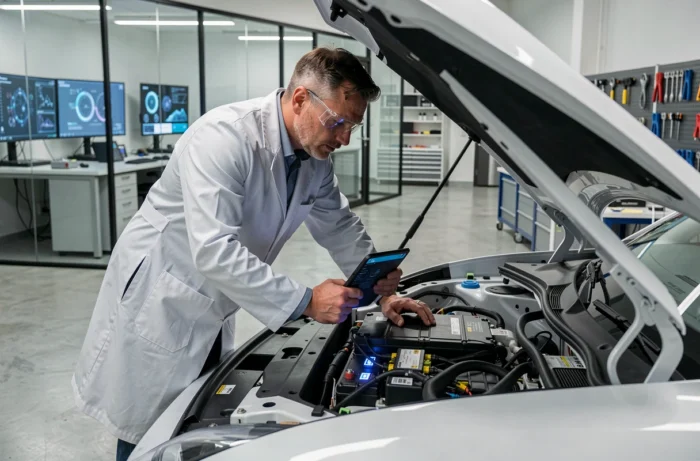
OTA updates are approaching 90% penetration on battery electric vehicles in the first half of 2026, according to a JATO analysis published on September 1, 2026. This figure marks a structural shift: software is no longer an added layer to the vehicle; it defines its architecture. Manufacturers that have not yet migrated to a software-defined model are accumulating a difficult-to-close gap in current product cycles.
Software-defined vehicle: what OTA penetration rates change for the automotive industry
The JATO analysis documents a very strong progression of all SDV indicators between 2021 and mid-2026. Remote services (locking, monitoring, management via smartphone) are now equipped on 76% of BEVs, compared to 63% of thermal vehicles.
This asymmetry is not coincidental. Zoned electrical architectures, with a reduced number of central processors, facilitate the deployment of global software updates. In a traditional thermal vehicle distributed across dozens of independent ECUs, the same operation requires heavier cross-validation.
Manufacturers are now structuring alliances around common OS and ECUs to pool these development costs. The logic is no longer to differentiate hardware but to control the software layer that generates recurring revenue after the sale.
To keep up with these technical evolutions and their implications for vehicle maintenance, resources like automotech.fr help anchor these topics in workshop practice.
Embedded artificial intelligence: generative cockpit and predictive diagnostics
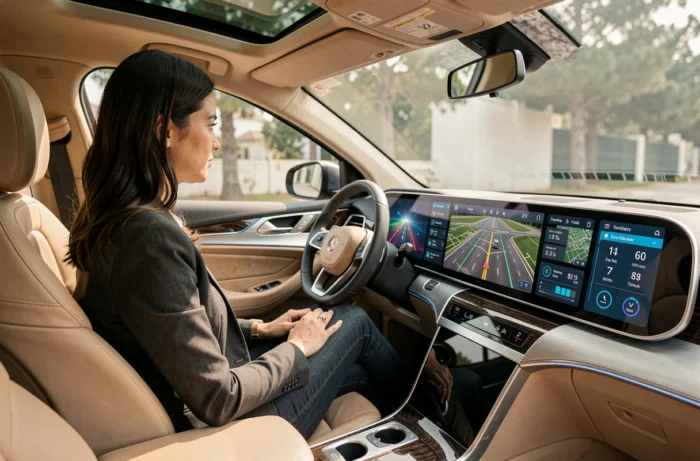
Generative AI is settling into the digital cockpit. Voice interfaces based on large language models are gradually replacing fixed menu commands. The driver formulates a request in natural language, the system interprets the context (navigation, climate, vehicle status) and executes a composite action.
The most structuring contribution concerns real-time predictive diagnostics. AI models continuously analyze sensor data streams (battery temperature, brake wear, suspension behavior) to anticipate a failure before it manifests. This is no longer calendar-based preventive maintenance; it is condition-based maintenance driven by algorithms.
Manufacturers that integrate AI from the design phase significantly reduce their validation cycles.
ADAS systems and multi-sensor perception
Advanced driver assistance systems progress in stages. Data fusion between cameras, radars, and LiDAR allows for redundancy that enhances the reliability of obstacle, pedestrian, and marking detection. Level 3 autonomous driving is being deployed on highways by several manufacturers, with legal responsibility shifting to the vehicle within the defined operational perimeter.
The main brake remains regulatory certification, not technological maturity. Current sensors and algorithms exceed human perception capabilities in standardized conditions. It is the legal framework that dictates the pace of deployment.
Digital battery passport: traceability imposed by European regulation
The European regulation on batteries mandates a digital passport accessible via QR code for industrial and electric vehicle batteries. This system requires complete traceability: chemical composition, origin of raw materials, manufacturing carbon footprint, residual capacity, and charging history.
For the automotive industry, the implications are concrete:
- Each battery must carry a unique identifier linked to an interoperable database, accessible by authorities, recyclers, and used vehicle buyers.
- Manufacturers must document the supply chain of lithium, cobalt, and nickel up to the assembled cell, forcing a rethinking of supplier relationships.
- The declared residual capacity directly conditions the resale value of the vehicle and eligibility for a second life in stationary storage.
This regulatory framework creates a competitive advantage for manufacturers that control their vertical supply chain. Those who depend on cells purchased on the open market will have to negotiate access to traceability data with their suppliers, complicating compliance.
Electrification and battery innovations: beyond driving range
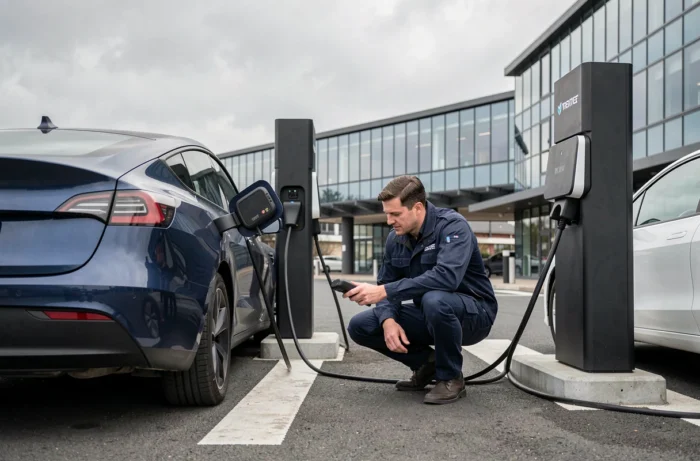
Solid-state batteries are attracting attention, but the real breakthrough lies in charging speed and durability. Current chemistries are improving in the number of cycles supported before significant degradation, a key parameter for total cost of ownership.
Manufacturers are also working on the thermal efficiency of packs. Optimized thermal management allows for maintaining the fast charging window longer and limits calendar degradation in hot climates. This point remains under-documented in most consumer technical sheets, even though it conditions the actual longevity of the electric vehicle.
Materials and structural lightweighting
Lightweighting electric vehicles partially compensates for the excess weight of batteries. High-strength steels, thermoplastic composites, and recycled aluminum alloys are becoming standard on dedicated platforms. Every kilogram saved on the structure translates directly into recovered range or reduced battery capacity at equal performance.
The automotive sector in 2026 is no longer just a race for electrification. The convergence of software, regulation, and material chemistry is redefining competitiveness criteria. Manufacturers that simultaneously manage these three axes have a differentiation lever that mere marketing power cannot replicate.