The edge of a book, whether it is the head, foot, or gutter, remains the most exposed area to mechanical and environmental damage. It is also the part that most conservation guides neglect in favor of the cover or spine. Protecting the book’s edge requires understanding the nature of the exposed material: raw paper cuts, without coating, that absorb dust, moisture, and contact oils.
Micro-cracks and flaking of the edges: the trap of rigid plastic
Laminating a book up to the edges with a rigid or acid plastic film has the opposite effect of what is intended. According to research shared by the Library of Congress Binding and Preservation Lab, rigid plastics applied to the edges increase the risk of micro-cracks and flaking of the page edges, particularly at the head, which is exposed to shocks and dust.
The mechanism is simple: the film constrains the paper fibers in a single direction. Due to hygrometric variations, the fibers swell and contract perpendicularly to the cut, and the rigid plastic prevents this natural movement. The result, after a few months, is a brittle page edge that crumbles at the slightest flipping.
We recommend stopping any cover film a few millimeters from the edge. Several techniques for protecting the book edge are based on this principle of intentional margin, which allows the fibers to breathe while covering the cover.
Headband and spine reinforcement: structural protection for the head and foot
On a bound book, the headband is not an ornament. This small textile ribbon glued at the head and foot of the spine serves a specific mechanical function: the headband prevents the block of pages from separating from the spine during repeated handling. When pulling a book by the headcap to remove it from a shelf, it is the headband that absorbs the stress.
On paperback books, this protection does not exist. The glued spine is directly exposed. We observe that the majority of edge damage on paperbacks comes from this act of extraction by the headcap. Two concrete countermeasures:
- Push the neighboring book back to grasp the book by the covers, never by the head of the spine
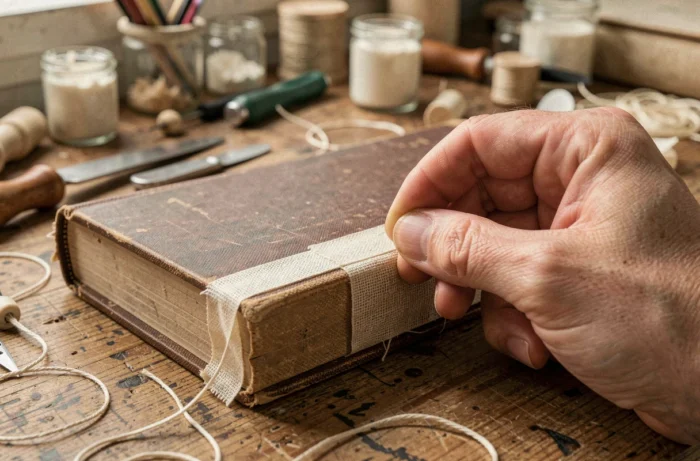
- Apply a strip of fine cloth (percaline or jaconas) to the head and foot of the spine with neutral PVA glue, extending a few millimeters onto the covers
- For old bindings where the headband is detached, reattach it with a reversible glue point before the block shifts
Drying after water damage: the method of absorbent interleaving
A wet book that is poorly dried becomes irreversibly deformed at the spine and edges. The standard professional technique involves interleaving absorbent sheets every twenty to thirty pages, allowing the interleaving to extend beyond the edge to drain moisture outward.
Interleavings are replaced as they become saturated, and the volume is regularly turned for even drying. This method better preserves the flatness and strength of the cuts than flat pressing or hairdryer drying, which cause warping and weakening of the edges.
The often overlooked point: never completely close the book during drying. The edges must remain open to the air so that evaporation occurs through the cuts, not through the spine where the glue would soften.
When to intervene on a warped book
If the edges have dried in a wavy manner, pressing between neutral pH boards for several days can partially correct the deformation. Beyond a few weeks after the incident, the deformation of the fibers becomes permanent.
Vertical storage and spacing: protecting the edge daily
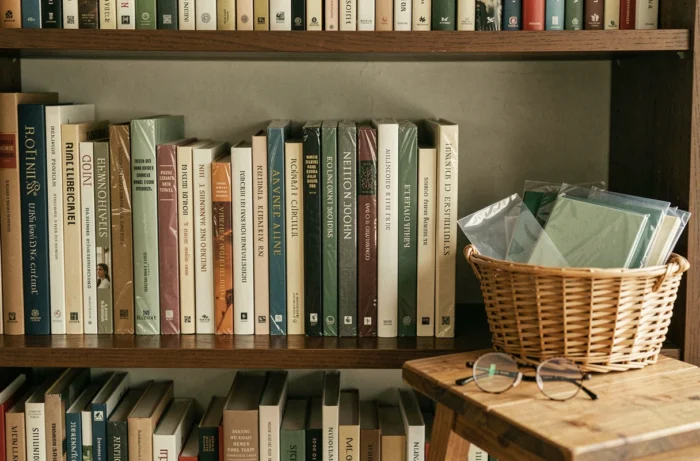
A book that is too tightly wedged between its neighbors compresses the side edges and prevents air circulation. An isolated book tips over, crushing the gutter under its own weight. The ideal spacing allows a finger to slide between two books without forcing.
Horizontal storage, often practiced due to lack of space, concentrates all the weight of the volume on the lower edge. We recommend never stacking more than three books and placing the heaviest on the bottom. For large formats (atlases, art books), flat storage remains preferable, provided that the head edge does not come into direct contact with the shelf: a neutral felt or a sheet of acid-free paper as a cushion is sufficient.
Gilding and edge coloring: an underestimated physical barrier
Edge gilding does not serve only a decorative function. The gold leaf applied to the edge seals the fibers and repels dust. This is why missals and old books of hours retain intact edges after several centuries.
On contemporary works, edge coloring (fore-edge coloring) with water-based inks partially serves the same role by filling the gaps between the pages. The result is a smoother surface, less conducive to particle accumulation. The technique requires a tightly bound block in a press before application and paper dense enough not to absorb the ink deeply.
Dusting the head edge: equipment and frequency
The head edge continuously captures dust. Regular dusting with a soft-bristled brush (like a bookbinder’s brush) prevents particles from embedding between the pages by capillarity. The correct motion goes from the spine to the gutter, never the reverse, to avoid pushing dust into the block.
- Minimum frequency: every three to six months for a home library, monthly in a dusty urban environment
- Avoid damp cloths on the edges: water instantly penetrates untreated cuts and causes rings
- For heavily soiled edges, a rubber crepe eraser (known as a bookbinder’s eraser) removes surface deposits without abrading the fibers
Protecting the edge remains a task of prevention more than repair. The actions are simple, the materials inexpensive, but regularity makes all the difference between a book that ages and a book that deteriorates.