A student entering a BTS program after having benefited from a PAP in high school sometimes faces an administrative wall: the plan does not automatically carry over, the contact person has changed, and no one knows exactly which document to submit. It is in this type of situation that the student support plan (PAE) makes perfect sense, serving as a continuity mechanism between secondary and higher education.
Portability of accommodations when changing institutions
One often starts by trying to understand what the student PAE is when confronted with a concrete blockage. The student transitioning from a high school to a university, or from one school to another during their course, discovers that their accommodations (extra time, reading software, adapted course materials) are not automatically transferred.
The reason is simple: each higher education institution manages its own procedures. The PAE or PAEH established at one university has no binding value at the next school. The process must be restarted, medical documentation must be provided again, and sometimes a needs assessment must be redone.
Keeping a complete copy of one’s medical file and previous accommodations is the first thing to do before any change. This personal file serves as a basis to expedite the new request, even if the host institution uses a different form.
When the institution does not have a structured disability unit
Large universities generally have a dedicated service with an identified disability contact person, request forms, and written decision-making processes. Feedback on this point varies, but small private schools or certain CFA may not always have this organization.
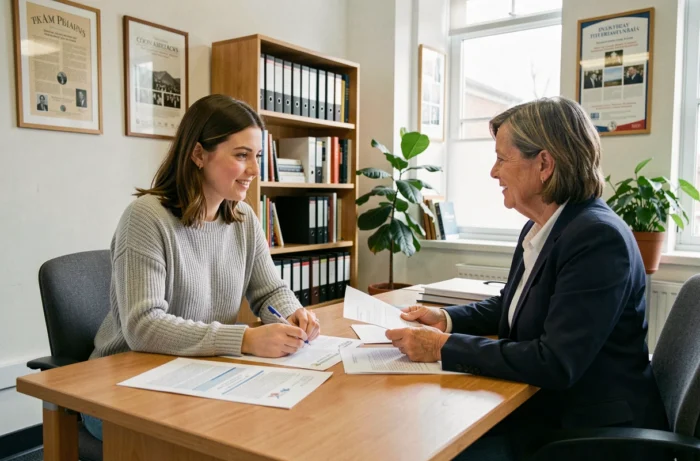
In this case, the student must directly contact the academic affairs office or the educational coordinator. The law requires every higher education institution to implement reasonable accommodations, even without a specialized service. Writing a request oneself, listing precisely the accommodations previously received, creates a record that obligates the institution to respond.
Student PAE: application process and required documents
The request for accommodations is increasingly treated as an early entry process, starting from the application or arrival at the institution, rather than as a formality after enrollment. Anticipating avoids being left without accommodations during the first exams.
Here are the documents to gather before contacting the relevant service:
- A recent medical certificate describing the disorders or disability, written by a specialist doctor or the attending physician as applicable.
- Notifications from MDPH or any document certifying a previous PPS, PAP, or PAI, detailing the accommodations granted (extra time, exam secretary, adapted materials).
- Reports or transcripts mentioning the accommodations actually implemented during previous exams, which serve as proof of usage.
- A personal letter describing specific daily needs in the targeted training (practical work, internships, lectures).
Submitting the file as soon as enrollment is confirmed allows the disability contact person (or the educational management) to plan the accommodations before the start of the semester. Waiting until October risks a first semester without adaptations.
Concrete accommodations beyond extra time in exams
The PAE is often reduced to extra time during exams. The reality of possible accommodations is much broader, and institutions that have formalized their procedures offer a range of support that goes beyond the strict framework of exams.
Adaptive supports and tools in class
Ergonomic furniture in classrooms, speech synthesis or transcription software, adapted typography on distributed documents, loan of specific equipment for practical work: these aids exist but must be explicitly requested. They are almost never offered spontaneously.
Occasional human support (note-taker, peer tutor) is also part of the available measures. For a visually impaired student in an engineering school, for example, providing course plans in accessible digital format radically changes daily follow-up.
Internships and work placements
The PAE does not directly cover internships, but the institution remains responsible for notifying the internship supervisor of the needs if the student wishes. Specifically, one can request that the internship agreement mentions the necessary accommodations (adjusted hours, ergonomic workstation).
Monitoring and reevaluation of the student support plan
A PAE is not fixed for the duration of the course. Needs evolve between the first year of a bachelor’s degree and a master’s degree, between a semester of lectures and a semester of field projects.
Most disability services plan for an assessment at least once a year. If this meeting is not proposed, one can request it. This assessment allows for adjustments to accommodations: adding support, removing unnecessary assistance, or modifying exam modalities for a specific UE.
Keeping a written record of each exchange with the contact person (confirmation email, signed report) protects the student in case of disputes or changes in contact persons during the year. It is a simple reflex that avoids having to explain everything again.
The number of students with disabilities supported in higher education continues to rise, prompting institutions to further structure their services. However, the burden of proof and initiative largely remains with the student. Assembling one’s file early, keeping it carefully, and formalizing each request in writing remain the three most reliable levers for ensuring that the support plan truly works, regardless of the institution.