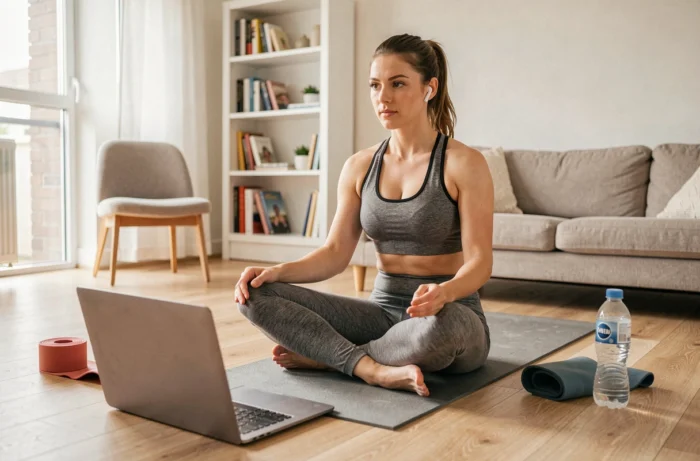
Online sports rely on a technical and regulatory foundation that most consumer guides overlook. Before choosing a program or an application, it’s essential to understand what distinguishes a reliable online course from a mere video stream without supervision. Engaging in online sports involves your body in a physically unsupervised environment, which alters the safety, programming, and monitoring requirements.
Regulatory Framework for Online Sports Coaching in France
A coach offering personalized support via videoconference (morpho-functional assessment, live corrections, ongoing monitoring) is engaged in a sports educator activity. Therefore, they must hold a recognized diploma, be registered with the administration, and possess a valid professional card for five years.
French law has not yet explicitly ruled on the case of remote coaching. No official document from the Ministry of Sports or any commentary on Légifrance specifically addresses this format. We recommend practitioners verify that their coach has indeed consulted their SDJES (departmental sports directorate) in writing to secure their online practice.
A new reference BPJEPS for fitness coaching came into effect in 2025. Its guidelines specify that the prerogatives also cover remote programs, provided the coach verifies the practitioner’s environment. The old mention “Activities of Fitness” will be gradually repealed starting November 1, 2027. Until then, both diplomas coexist, creating a gray area regarding the actual qualifications of some online coaches.
In practice, before subscribing to an online sports program, ask the coach for their professional card number. This number can be verified on the ministry’s website. A provider who refuses to share it or does not have one offers no guarantee of compliant supervision.
To find practical information on Online Sports and compare available offers, it’s best to cross-reference multiple sources before committing to a subscription.
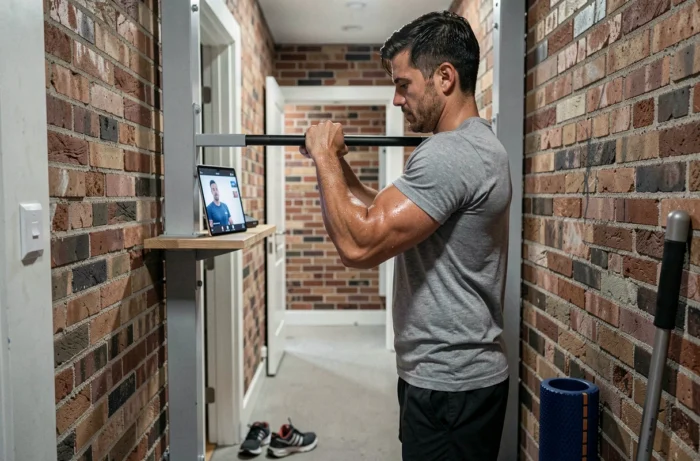
Video Latency and Postural Correction: The Technical Limits of Home Sports
A group class via videoconference introduces a delay between the coach’s movement and what you see on the screen. This delay, even if just a few hundred milliseconds, prevents any real-time postural correction on fast movements like a clean or a burpee.
Asynchronous formats (pre-recorded videos, PDF programs) completely eliminate feedback. Without visual feedback from the coach, the risk of joint compensation increases, especially on bodyweight polyarticular exercises: deep squats, reverse lunges, deficit push-ups.
We observe that the most reputable platforms now integrate a delayed video feedback system. The practitioner records themselves, sends the clip, and the coach annotates the corrections. This method bypasses latency but requires processing time and often a subscription that is more expensive than simple access to live classes.
Minimal Equipment for Effective Online Training
The promise of “no equipment” has its limits. A serious home fitness program requires at least:
- A sufficiently thick exercise mat to protect the knees and elbows during floor work, not a thin yoga mat
- A stable internet connection with sufficient download speed for HD video streaming; otherwise, the coach appears pixelated and demonstrations become unreadable
- A clear space of at least four square meters, with a ceiling high enough for overhead arm movements
- A mirror or secondary screen positioned to compare your posture with that of the coach during the exercise
Many practitioners underestimate the spatial constraint. A cluttered living room forces movement adaptations that alter the biomechanics of the exercise and reduce its effectiveness.

Programming and Periodization in an Online Training Context
A good online program follows a periodization logic, just like in a gym. Most applications offer isolated sessions without structured progression over several weeks. This format is suitable for maintaining light physical activity, not for making progress.
A structured program alternates accumulation blocks (high volume, moderate intensity) and intensification blocks (reduced volume, increased loads or difficulties). In bodyweight training, progression involves manipulating levers: elevating feet in push-ups, pistol squats instead of classic squats, slowed eccentric tempo.
Warning Signs of a Poorly Constructed Program
Several indicators can help identify an online course that lacks rigor in its programming:
- Each session is independent of the previous ones, without a guiding thread or weekly objective
- The workload is the same each week, without a deload phase or lighter week
- Exercises change constantly (the “variety” effect) without actual progression in difficulty
- No distinction is made between levels; everyone follows the same stream
Variety is not a training plan. Changing exercises every day prevents the neuromuscular adaptation that produces strength and endurance gains.
GDPR and Health Data Collected by Sports Applications
Online sports applications collect sensitive data: heart rate, weight, measurements, training history, sometimes videos of the practitioner. This information falls under health data as defined by the GDPR and requires enhanced processing.
Before creating an account, check the privacy policy. A self-employed coach who stores your assessments on Google Drive without encryption violates the GDPR. Structured platforms host this data on compliant servers and allow deletion upon simple request.
This point is rarely addressed in the usual advice on home sports, but it conditions the trust you can place in a digital provider. An online fitness program that does not mention its personal data processing policy in its general terms should be dismissed outright.
The practice of online sports is gaining regulatory and technical maturity, but the market remains heterogeneous. Verifying the coach’s diploma, requiring a periodized program, and reading the data policy before signing up remains the basic triad for filtering serious offers.