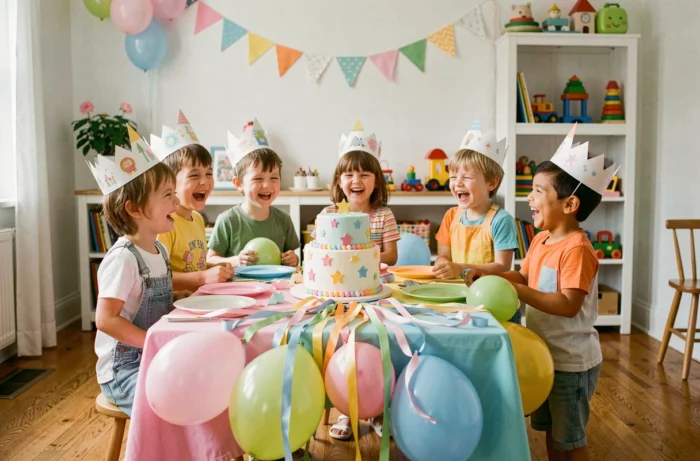
Organizing a children’s birthday party involves juggling the expectations of the small invited group, the constraints of the venue, and a regulatory framework that most planning guides overlook. Before even choosing a theme or an activity, several concrete parameters need to be established to avoid disappointments on the big day.
Noise disturbances and birthday parties: the often-unknown legal framework
Content that lists party ideas almost always omits a central point: no national text guarantees that one can make as much noise as they want before 10 PM. The belief that noise is free during the day has no precise legal basis.
Since the law of April 15, 2024, and Article 1253 of the Civil Code, the judge assesses noise disturbance based on duration, frequency, time, and context. A quiet building in the city center does not offer the same tolerance as a house in a spacious residential area.
In practical terms, a powerful sound system in the garden, inflatable structures used in the late afternoon, or late animations can constitute a nuisance to neighbors that is punishable, both day and night. Local municipal orders sometimes add additional restrictions that are best consulted before finalizing the program.
This framework does not mean that a lively party is prohibited. It requires calibrating the volume, duration, and timing of noisy activities, especially in shared housing. Informing the neighbors remains the most effective precaution, well before any legal considerations.
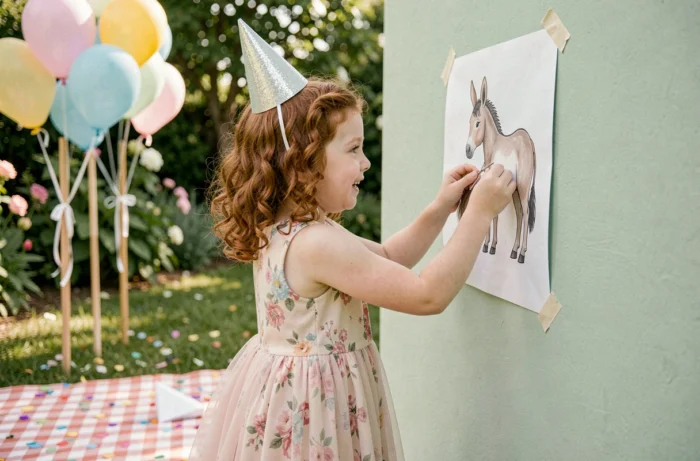
To find suitable animations and party accessories for children, several specialized providers facilitate the organization, as seen on https://www.frimousse-et-coccinelle.fr/, which offers equipment and ideas designed for the youngest.
Children’s birthday activities that really last
Most lists of ideas line up dozens of activities without specifying how long each actually keeps a group of children occupied. The main problem of a failed birthday is not the lack of ideas; it’s the twenty-minute gap where no one knows what to do.
Home escape game or themed treasure hunt
A home escape game, built around age-appropriate puzzles, can keep a group occupied for an hour or more. The difference from a simple treasure hunt lies in the narrative progression: each step unlocks the next, which maintains attention without constant adult intervention.
The scenario must be tested before the big day, ideally with the child celebrating their birthday. A puzzle that is too difficult can block the entire group, and the children will lose interest in just a few minutes.
Creative workshop with a take-home result
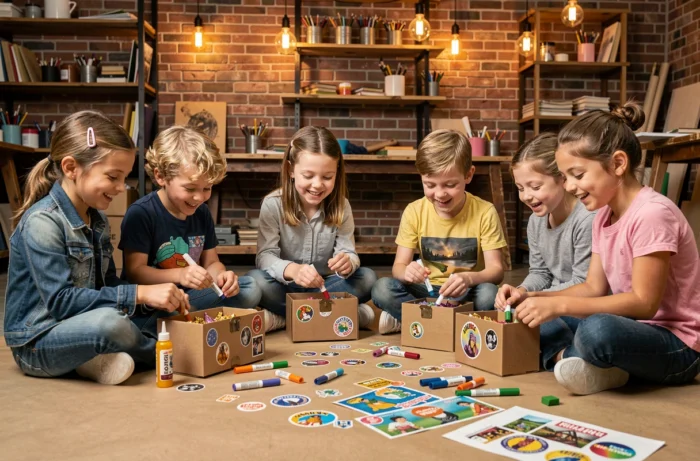
Baking, painting, or crafting workshops work well because they combine hands-on activity with a tangible memory. Each guest leaves with their creation, which is a much better alternative to the traditional bag of candy.
The workshop format requires preparing enough materials and planning for drying or cooking time. Count on at least forty-five minutes for a workshop that is not rushed.
Birthday party at home or outdoors: deciding based on age
The choice of venue depends less on the budget than on the number of children invited and their age. A group of six four-year-olds in a medium-sized apartment remains manageable. Twelve eight-year-olds in the same space, much less so.
- For four to six-year-olds, home is often the most reassuring setting. Children of this age tire quickly, and quiet times (coloring, reading) naturally alternate with active games, and the proximity of the kitchen simplifies snack time.
- Between seven and ten years old, outdoor activities (park, leisure center, treetop adventure) make much more sense. The need to run and expend physical energy dominates, and the space of a living room quickly becomes too cramped.
- From eleven years old, immersive formats (escape rooms, virtual reality, laser tag) better match the group’s expectations. Pre-teens want experiences they can talk about at school, not a treasure hunt with paper clues.
However, an outdoor activity requires a weather contingency plan. Booking a slot in a park without a backup solution in case of rain turns the party into a stressful improvisation for everyone.
Children’s birthday animations: what gets stuck in practice
Several popular formats pose difficulties that are rarely mentioned in classic guides.
Inflatable structures rented for a garden generate a continuous noise level (blower motor, children’s screams while bouncing) that can quickly become problematic with the neighbors. The blower of an inflatable castle runs continuously and can be clearly heard several dozen meters away.
Animations with an external performer (magician, balloon sculptor, sports animator) require checking their professional liability insurance. In case of an accident during the performance, the question of coverage arises immediately.
Cooking workshops, which are very popular, involve managing the food allergies of each guest. Asking for this information on the invitation card, in advance, avoids awkward situations on the day itself.
Budget and organization: often underestimated items
The cake and decorations represent only a fraction of the actual cost of a birthday. The items that inflate the bill without being anticipated are more mundane.
- The gift bags distributed to guests at the end of the party. Multiplied by ten or twelve children, they can represent a significant budget if something other than candy is included.
- The rental of equipment (sound system, inflatable structure, extra tables and chairs) which adds to the cost of the main activity.
- The time for preparation and cleanup, often underestimated. Plan for at least two hours of cleanup after a party for ten children is a realistic minimum.
Setting a global budget before choosing activities, rather than the other way around, helps avoid the accumulation effect where each small addition seems trivial but where the total far exceeds what was planned. A successful party relies more on the rhythm of activities and their sequence than on the amount of resources deployed.