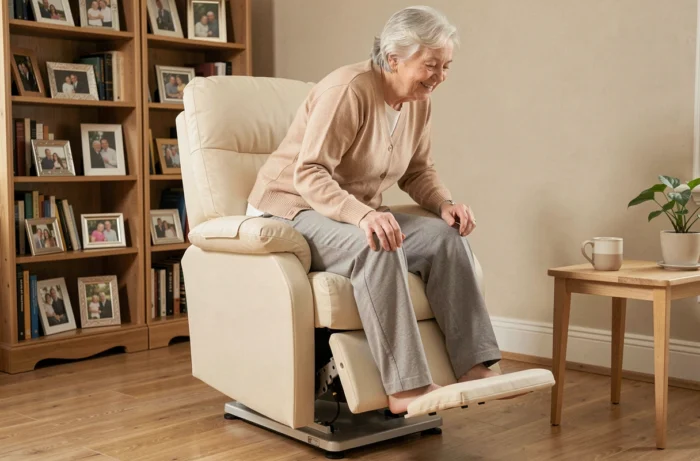
The electric lift chair sold in comfort stores or medical supply stores is not listed on the List of Products and Services (LPP) of Health Insurance. This distinction between living room furniture and medical device registration affects the entire reimbursement process. Confusing the two products means wasting time on a file that will be systematically rejected.
Registration to the LPP: the criterion that separates lift chairs and shell chairs
A classic lift chair, even equipped with an electric motor and sold by a medical equipment dealer, remains a piece of comfort furniture. It does not have an LPP code. Without this code, no coverage by Health Insurance is possible, regardless of the pathology or prescription.
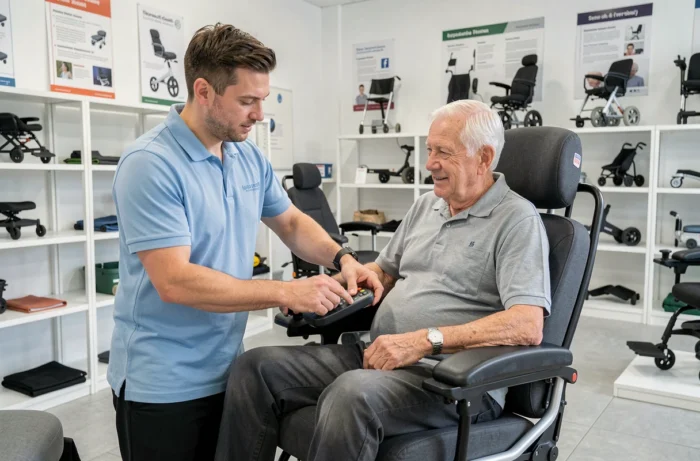
The reimbursable product is the shell chair with lift function. This medical device includes lateral support, an adjustable headrest, a trunk support, and sometimes positioning straps. Its design meets a specific therapeutic specification, which justifies its registration to the LPP.
We regularly observe families purchasing a living room lift chair on the advice of a salesperson, thinking they will obtain reimbursement afterward. The rejection is automatic. The question of whether one can obtain a reimbursable electric lift chair from social security primarily depends on the regulatory category of the product, not its appearance or price.
Medical prescription and prior approval for a lift shell chair
A prescription alone is not enough. For a shell chair with lift function, the procedure requires a detailed medical prescription, written by the attending physician or a specialist. This prescription must mention the pathology justifying the equipment, the type of shell chair desired, and the necessity of the lift mechanism.
A prior agreement from the Health Insurance fund is generally required. The approved supplier submits the prior agreement request (DEP) to the consulting physician. If there is no response within fifteen days, the agreement is deemed granted. In case of refusal, the letter specifies the reason and the means of appeal.
Elements to check before submitting the request
- The chosen shell chair must have a valid LPP code, verifiable with the supplier or on the Ameli database.
- The prescriber must argue the insufficiency of alternatives (wheelchair, transfer aid) to justify the lift shell chair.
- The quote from the approved supplier must distinguish the LPP reimbursement base from the remaining charge, as the commercial price almost always exceeds the Social Security base.
Purchasing from a pharmacy or an approved service provider does not change the reimbursed amount. What matters is the product’s LPP code and adherence to the prior agreement procedure.
Remaining charge and complementary financing outside Social Security
The Social Security reimbursement base for a shell chair is often much lower than the selling price. The remaining charge can represent a significant portion of the total cost. Several mechanisms allow for reducing this difference.
Health mutuals and enhanced contracts
Some mutuals provide an annual allowance for medical equipment or fittings. So-called “enhanced” contracts sometimes cover the difference between the LPP base and the actual price. We recommend checking the reimbursement caps before placing any order, as the guarantees vary significantly from one contract to another.
PCH and MDPH: an alternative for those under 60
The Disability Compensation Benefit (PCH), administered by the MDPH, can finance a lift chair, including a model not listed on the LPP, if the file demonstrates that the equipment compensates for an activity limitation. This pathway is distinct from that of Health Insurance and primarily concerns individuals under 60 years of age with recognized disabilities.
For individuals over 60, the APA (Personalized Autonomy Allowance) can theoretically include a chair in the aid plan, but the amounts allocated for equipment remain modest compared to the cost of a lift chair.
MaPrimeAdapt’: housing adaptation
Since 2024, MaPrimeAdapt’ finances housing adaptation work for seniors and people with loss of autonomy. The lift chair does not directly fall within the scope of this aid, which targets fixed adaptations (shower, ramp, stairlift). Some files attempt to include a lift chair as complementary equipment, but approvals remain marginal.
100% Health Reform for wheelchairs: what it changes for lift chairs
Since December 1, 2025, wheelchairs (manual, electric, sports, modular scooters) benefit from enhanced coverage under the 100% Health system. This reform has expanded the basket of reimbursable care for mobility.
However, living room lift chairs remain excluded from this system. The reform has even heightened the regulatory treatment gap between wheelchairs (now better covered) and lift chairs (still outside the LPP for comfort models). For families, this evolution can create additional confusion.
The shell chair with lift function retains its previous reimbursement regime. No extension of the 100% Health to shell chairs has been announced at this stage.
Before making a purchase, the most reliable approach remains to contact your Health Insurance fund directly with the LPP code of the product being considered. A chair without a registered code will never be reimbursed, regardless of the purchase channel or the severity of the pathology.