Elevating your style on a daily basis does not rely on the accumulation of trendy pieces, but on understanding a few precise clothing mechanisms. The choice of proportions, the coherence of materials, and the mastery of colors form the foundation of a personal look that endures, season after season.
Proportions and volumes: the most underestimated stylistic lever
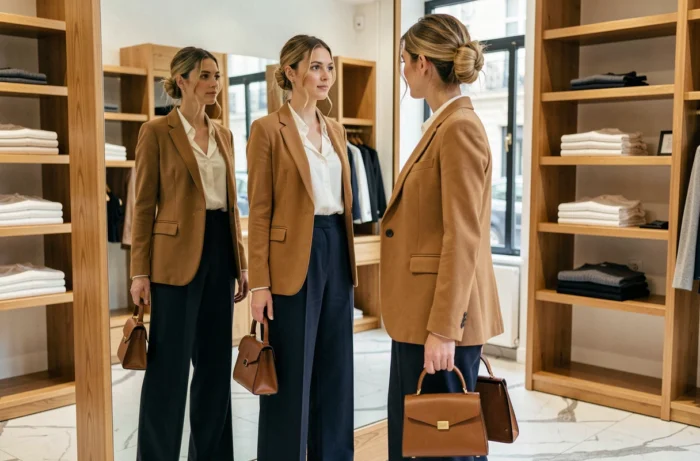
Before discussing colors or prints, the silhouette is constructed through the relationship between the volumes on the top and bottom. Wide pants paired with a fitted top create a visual balance that is different from an entirely oversized outfit. This play of proportions determines the overall look much more than the choice of a brand or an isolated piece.
Every silhouette benefits from identifying its preferred top/bottom ratio. A structured top tucked into high-waisted pants elongates the leg. Conversely, a fluid top worn over skinny jeans creates a relaxed line. The basic rule: only one loose volume per outfit, rarely two.
This principle also applies to dresses. A straight dress without a belt creates a column line, while a belt placed above the natural waist completely alters the perception of proportions. Testing these variations on one’s own basics, as detailed in the fashion section of Les Conseils de Mélanie, allows for quick identification of what works for one’s body shape.
Coherence of materials: assembling textures without a false note
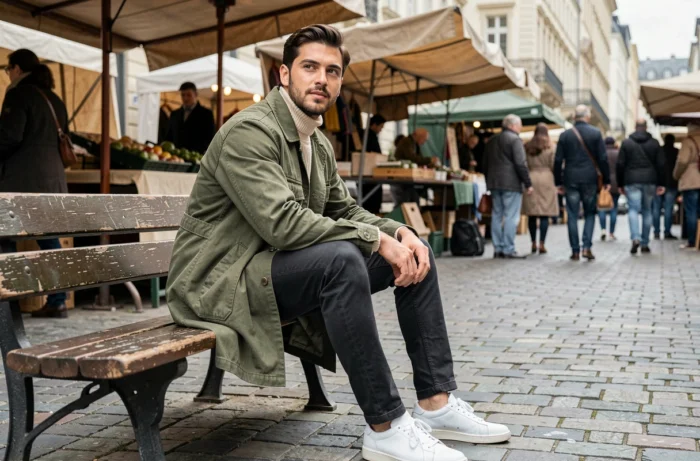
Wearing multiple textures in the same outfit adds visual depth. The trap is mixing materials that do not share the same register or season. Crumpled linen paired with patent leather creates a mismatch that blurs the readability of the look.
Combining materials of similar weight avoids unintentional contrasts. In winter, ribbed knit pairs well with velvet or wool fabric. In warm seasons, poplin cotton matches with linen or lightweight viscose. This textile thread gives the ensemble a logic that the eye perceives without analyzing.
Layering works on the same principle. Stacking a jersey t-shirt, a flannel shirt, and a wool coat creates a coherent gradation of textures. Replacing flannel with satin would disrupt this progression.
Special case of prints
A print counts as a texture. Two prints in the same outfit are not a problem as long as the scales vary: a fine pattern (millimeter stripes) can coexist with a large pattern (bold checks). Two patterns of the same size compete visually.
Daily color palette: building your associations
Color remains the most visible parameter of an outfit, and the one that generates the most hesitation. Working with a limited palette significantly simplifies the daily dressing process.
The principle of the chromatic core consists of defining three to four base shades in your wardrobe (including neutrals), then varying them across different pieces. These colors combine effortlessly, reducing the time spent in front of the closet.
- A dark neutral (navy, charcoal, black) serves as the foundation for most outfits and structures the silhouette.
- A light neutral (ecru, beige, off-white) adds contrast and lightens overly dense combinations.
- A signature color (burgundy, pine green, terracotta) personalizes the ensemble and avoids chromatic monotony.
- A punctuated accent (scarf, bag, shoes in a bright hue) is enough to energize a look built on sober bases.
This palette approach works regardless of the season. Colors change, but the logic of association remains the same. In winter, neutrals lean towards brown and gray. In summer, the bases lighten towards sand and white.
Second-hand and style renewal: what platforms really change
Buying second-hand clothing changes the way one builds a style, but not all forms of second-hand produce the same effect on the wardrobe. An Oxfam report published in September 2026 clearly distinguishes between charity shops and online platforms like Vinted, which the NGO describes as “fast fashion of second-hand clothing”.
The carbon footprint differs significantly depending on the circuit: for an equivalent quantity of clothing, charity shops pollute much less than digital platforms. This observation goes beyond ecology. Online second-hand promotes a logic of frequent micro-purchases, quickly resold, which encourages constant renewal of looks rather than building a coherent wardrobe.
For daily style, the difference is tangible. Shopping in physical stores requires more selective sorting (limited stock, no algorithmic filtering). This constraint encourages choosing pieces that are truly complementary to the existing wardrobe, rather than succumbing to the allure of a low price on a piece disconnected from the rest.
Building rather than accumulating
The most effective stylistic reflex with second-hand remains to start from what is missing. Identifying a gap in your color palette or the absence of a key material (a wool blazer, velvet pants) before searching helps avoid impulse purchases that dilute overall coherence.
A daily style that holds up relies less on the number of pieces than on their ability to work together. Proportions define the silhouette, materials provide texture, and colors ensure unity. Each new purchase, whether new or second-hand, deserves to be evaluated through these three filters before joining the closet.