Opening a jar, getting up from a low chair, reaching for an object stored high: these seemingly trivial actions can sometimes become real obstacles with age. Choosing the right equipment for seniors helps maintain true autonomy at home, without waiting for an incident to necessitate urgent changes.
Funding for senior equipment: what MaPrimeAdapt’ really changes
Before discussing objects, we need to talk about money. Since 2024, the MaPrimeAdapt’ scheme funded by ANAH covers part of the major adaptation works for housing: walk-in showers, stairlifts, motorized shutters.
It replaces several old aids, simplifying the process but requiring a prior assessment by an occupational therapist or an accredited operator.
Meanwhile, DREES reports a decline in social home care for the elderly in 2025, with a decrease in the number of home beneficiaries. In practical terms, public funding for small daily equipment is tightening. To find reliable information on equipment on La Revue des Seniors, each product category is detailed with its selection criteria.
It’s better to anticipate: identifying available aids before purchasing helps avoid paying full price for a shower seat or grab bar that could have been partially reimbursed.
Bathroom safety: equipment that truly reduces falls
The bathroom accounts for the majority of domestic accidents among the elderly. Have you noticed that stepping over a bathtub edge requires a balance that gradually diminishes? This is the first area to address.
Step-free shower
Replacing the bathtub with a threshold-free shower eliminates the main obstacle. The ultra-flat shower tray, installed at floor level, allows for normal walking entry. A non-slip floor covering completes the installation.
Grab bars and shower seats
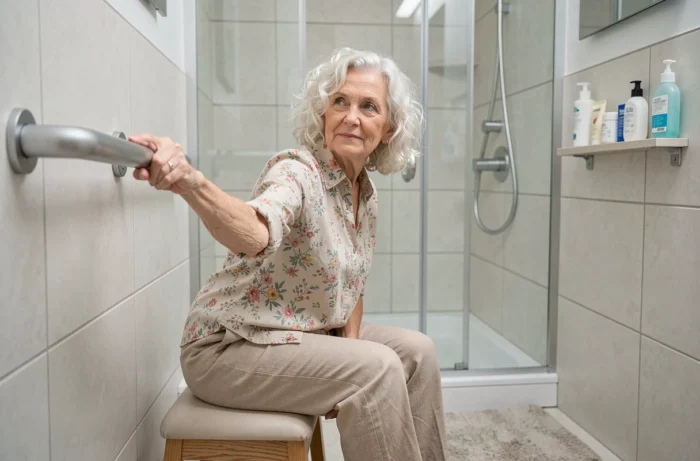
A well-placed grab bar reduces the risk of falling more than a non-slip mat alone. The installation must be done in a load-bearing wall, not on simple drywall. A foldable shower seat provides a stable sitting point for washing while not taking up space when not in use.
- 135° angled grab bar near the toilet: helps to stand up without straining the shoulders
- Thermostatic faucet: limits maximum temperature and prevents burns
- Toilet riser with armrests: reduces the range of knee bending movement
These pieces of equipment can be prescribed by an occupational therapist as part of the APA (personalized autonomy allowance) or included in a MaPrimeAdapt’ file.
Teleassistance and connected health devices: beyond the simple alert button
The classic alert pendant has existed for decades. However, teleassistance devices have evolved far beyond the red button around the neck.
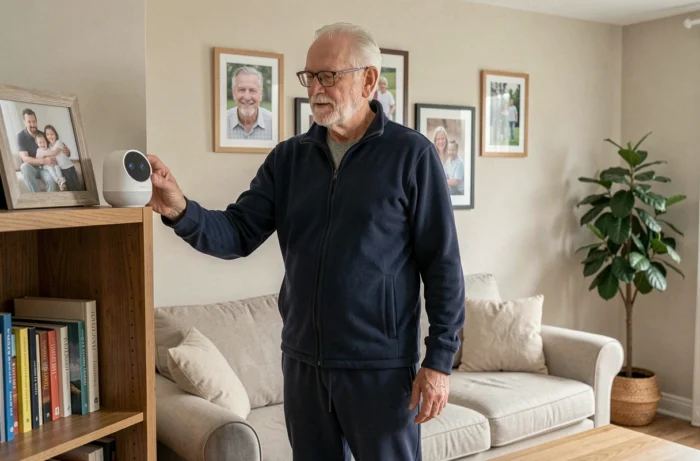
Motion sensors installed in the home detect abnormal inactivity. If the person does not get up in the morning or does not pass in front of a sensor for several hours, an alert is sent to a relative or a monitoring center. This type of device works without action from the person, making it suitable for seniors who forget to wear their pendant.
On the connected health side, blood pressure monitors and pulse oximeters linked to an app allow for remote monitoring by a caregiver or professional. The big-button phone remains a relevant choice for those who find smartphones too complex: readable screen, physical buttons, programmable SOS button.
Why choose this over a simplified smartphone? Because the reliability of an emergency call takes precedence over versatility. A dedicated phone does not run out of battery in a few hours and requires no updates.
Lift chair and adjustable bed: comfort that preserves autonomy
Getting up from a low seat engages the quadriceps and balance. When these abilities diminish, two pieces of equipment can radically change daily life.
The electric lift chair tilts its seat forward to assist the standing motion. It does not replace muscle strength; it complements it. A good lift chair reduces dependence on a caregiver for every stand-up.
The height-adjustable bed, sometimes called a medical bed, allows for adjusting the sleeping position. Raising the upper body facilitates nighttime breathing and reading. Lowering the bed to the maximum reduces the risk of falling when getting out. Recent models visually integrate into a classic bedroom, far from the hospital image.
- Lift chair: check the seat depth (suitable for the person’s size) and the presence of a removable cover
- Adjustable bed: prefer a model with a large-button remote and “zero gravity position” function for back relief
- Positioning cushion: a low-cost addition that stabilizes the pelvis or legs to limit pressure points
Automatic lighting and motorized shutters: details that change the night
Nocturnal falls pose a major risk. Getting up to go to the bathroom in the dark, searching for a switch, tripping over furniture: this scenario is common.
Motion-detecting light paths turn on as soon as the person places their foot on the ground. No button to search for, no harsh glare. LED models consume very little and plug into a standard outlet.
Motorized roller shutters eliminate the physical manipulation of a crank or strap. Programmed to open in the morning and close in the evening, they also regulate indoor temperature. Automating these repetitive actions preserves the joints of the shoulders and wrists.
Adapting one’s home is not just a shopping list. The order of priorities depends on each person’s vulnerabilities. The most cost-effective changes are often the simplest: securing the bathroom, installing night lighting, ensuring that help can be called without effort. The rest can wait, as long as funding has been anticipated.