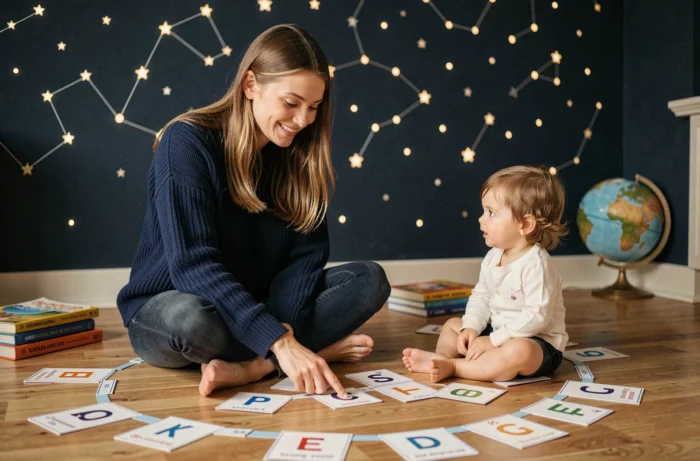
Associating the letters of the alphabet with stars and constellations engages two rarely combined learning channels: visual-spatial perception and graphic recognition. Several playful methods exploit this intersection, from light tracing applications to hands-on workshops and connect-the-dots games. Which approaches yield the most concrete results in letter memorization, and how do they compare in terms of skills developed?
Tracing constellations and fine motor skills: what hands-on workshops bring
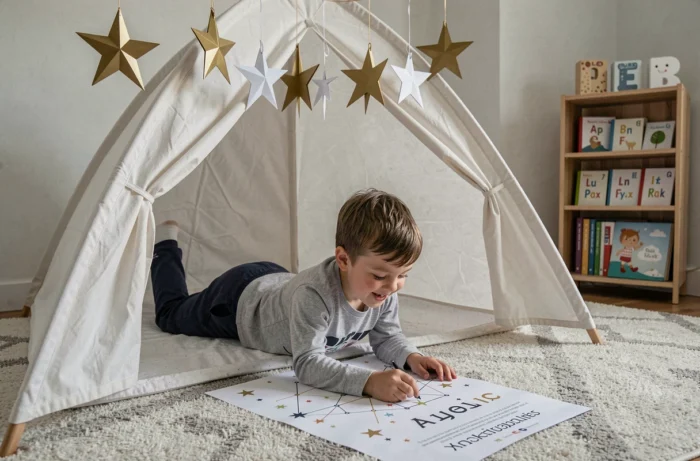
Children’s museums have been offering workshops called “Constellation Exploration” for a few years now. The principle: the child reproduces a constellation on paper, punches each star, and then observes the pattern by placing it in front of a light source. This punching action engages fine motor skills in a way that traditional coloring does not.
Adapted for letter learning, this format becomes a reverse tracing exercise. The child does not draw the letter directly: they punch star points arranged in the shape of an A, B, or M, and then check the result by transparency. The visual control through light corrects the error without adult intervention, which alters the learning loop.
For those who wish to learn with Declic Web, the list of stars associated with each letter provides a concrete starting point for creating these punched cards at home.
The educational interest lies in the combination of three actions: identifying the position of the point, punching with precision, and validating visually. In preschool, this sequence simultaneously works on hand-eye coordination, memorization of letter shapes, and the ability to follow a spatial model.
Light tracing applications and letters in constellations: a comparative skills table
Connect-the-dots applications for children now incorporate letters traced as luminous constellations. The child connects stars on the screen to form each letter, with immediate visual feedback. This digital format differs from the paper workshop on several criteria.
| Criterion | Paper workshop (punch) | Constellation application |
|---|---|---|
| Fine motor skills | Strong (pressure, orientation of the punch) | Moderate (sliding finger on screen) |
| Visual-spatial perception | Strong (locating points on paper) | Strong (locating luminous points) |
| Error correction | Visual by transparency | Automatic by the application |
| Child’s autonomy | Medium (materials to prepare) | High (immediate access) |
| Sensory stimulation | Tactile and visual | Mainly visual |
| Reusability | One card per letter | Unlimited |
The paper workshop develops fine motor skills more, as the punching action requires calibrated pressure that sliding on a screen does not replicate. On the other hand, the application offers immediate correction that speeds up the trial-error loop, an advantage for children who quickly get discouraged by a blurry result.
Which format for which age
For children aged two to three years, the digital format offers the advantage of simplicity: no punch to handle, no risk of tearing. The light tracing captures attention and associates each letter with a memorable visual effect.
From the age of four, the paper workshop becomes particularly meaningful. The action becomes more precise, and the validation through light adds a sensory dimension absent from the screen. Combining both formats in the same week allows for varying the channels without tiring the child.
Starry letter games on paper: three activities to try
Beyond punching workshops and applications, several paper activities exploit the stellar theme to anchor letter recognition.
- The alphabetical sky map: on a large dark sheet, the child sticks golden stickers following the outline of each letter, creating their own “alphabet constellation” that they can read and complete over the days
- The star-letter matching game: cards show a simplified constellation on one side and the corresponding uppercase letter on the other, the child flips the pairs like in a classic memory game
- The starry path on the ground: paper stars each bearing a letter are placed on the ground, the child jumps from star to star naming the letter or the associated sound, adding a global motor component to the exercise
These three formats share a common point: the child physically manipulates the letter in a narrative context (space, stars, exploration), which promotes encoding in episodic memory.
Letters, sounds, and astronomy: why the spatial theme enhances memorization
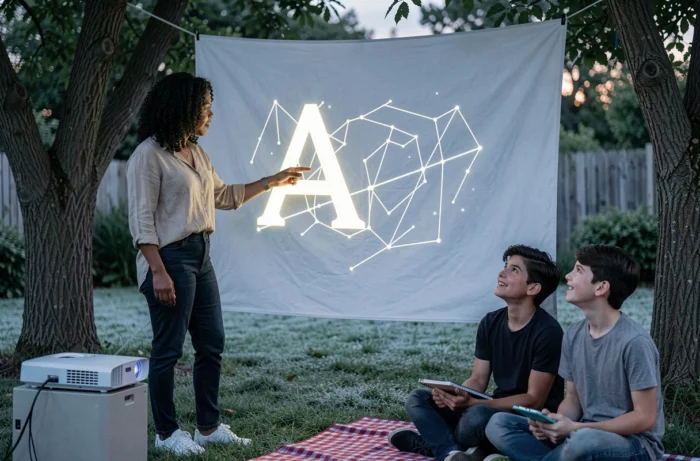
The association between letters and stars is not based on mere decorative embellishment. The spatial theme provides a coherent narrative framework that gives meaning to the tracing or recognition activity. A child who “draws the constellation of S” does not perceive the exercise as a school task, but as an exploration.
Some recent educational programs combine astronomy, body movement, and phonetics for children aged two to four years. The principle: each letter is associated with a space object (planet, moon, star) whose name starts with that letter, and the child mimics the corresponding movement (turning like a planet, shining like a star).
This triple association, visual, auditory, and kinesthetic, engages three memories simultaneously. The light tracing or constellation punching adds the spatial dimension. The result: the child has multiple pathways to retrieve the shape and sound of a letter.
Limitations to keep in mind
The stellar theme works as long as it remains a support, not an end in itself. If the activity focuses too much on astronomy at the expense of letter recognition, the educational objective dilutes. A good indicator: after the activity, can the child name the letter without the starry support?
Alternating between thematic activities (constellations) and neutral exercises (magnetic letters, writing on a slate) allows for checking that the letter is memorized independently of the spatial context. The transfer to a non-thematic support remains the true marker of learning.