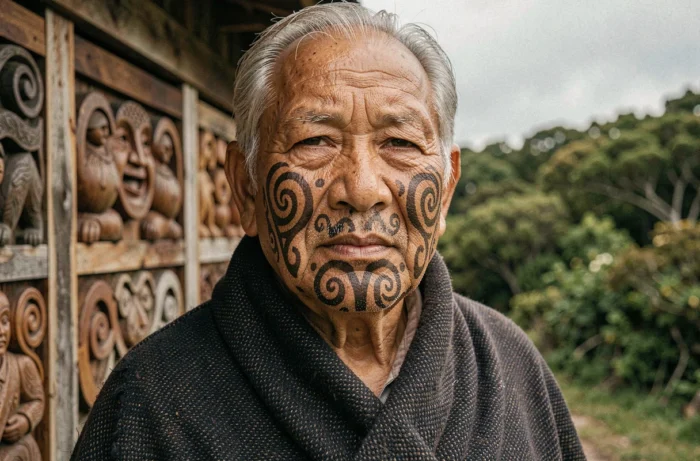
The tā moko refers to the traditional tattoo of the Māori people of New Zealand. Carved into the skin using techniques and protocols passed down through generations, it is not merely body decoration. Each line, each curve encodes precise information about the genealogy, status, and life journey of the person wearing it.
Tā moko and kirituhi: two Māori tattoo practices not to be confused
The distinction between these two terms is crucial for understanding Māori motifs. The tā moko is reserved for individuals of Māori descent. It is performed by a tohunga tā moko (master tattooist) and tells the tribal identity, family lineage, and personal achievements of the wearer.
Kirituhi, on the other hand, is aimed at those outside Māori culture. It incorporates Polynesian stylistic elements without claiming to carry a whakapapa (genealogy). Confusing the two amounts to ignoring the sacred dimension of tā moko and exposing oneself to a form of cultural appropriation that Māori communities actively denounce.
To delve deeper into the meaning of Māori motifs on Belle et Épanouie, this distinction between tā moko and kirituhi is a useful prerequisite.
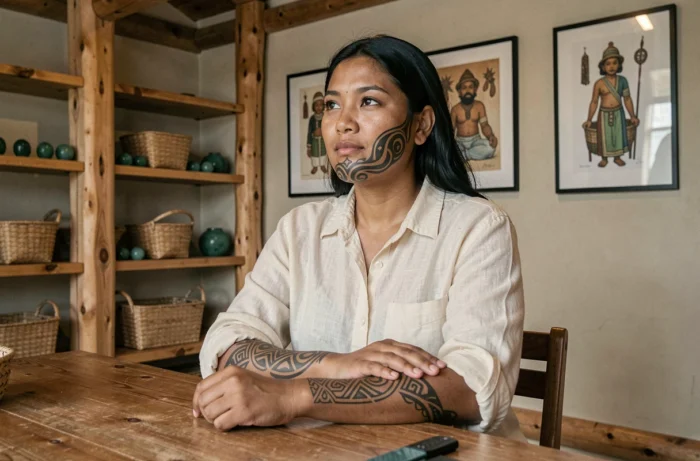
Moko kanohi: what Māori facial tattoo encodes on the face
The moko kanohi (facial tattoo) represents the most sacred form of tā moko. The face is considered the seat of identity in Māori culture, and each area corresponds to a type of information.
- The center of the forehead (ngakaipikirau) indicates social rank and status within the tribe (iwi).
- The areas around the eyebrows and eyes (ngunga) provide information about the position in the family hierarchy and the roles held.
- The cheeks and jaw carry information about the whakapapa, the paternal lineage on one side, maternal on the other.
- The chin, for women, receives the moko kauae, which marks maturity and the connection to female ancestors.
Each moko kanohi is unique, designed specifically for an individual. Two tattooed faces never bear the same lines because no two stories are alike. This uniqueness sharply contrasts with the catalog logic that dominates contemporary tattooing.
Colonial prohibition and political renaissance of tā moko
The tā moko nearly disappeared. Under British colonial rule, authorities criminalized this practice in the early 20th century. Wearing a facial tattoo became an act subject to penalties, and the transmission of knowledge between master tattooists gradually ceased.
The repeal of these laws in the 1960s-1970s paved the way for a reclamation. The Māori renaissance movements of the 1970s repositioned tā moko as an act of political resistance. The facial tattoo was no longer just a heritage to preserve, but a gesture of protest against the cultural erasure endured for decades.
The moko kanohi in public space today
This resurgence has accelerated since the early 2020s. Young Māori now wear moko kanohi as a statement of cultural sovereignty, visible on television, in the New Zealand Parliament, and on social media. The tā moko has become a marker of contemporary identity struggles, not merely a relic of the past.
This new visibility does not come without tensions. Cases of discrimination have been documented, particularly in New Zealand schools where Māori students have been asked to remove their facial markings. These incidents remind us that the recognition of tā moko remains a live political issue.
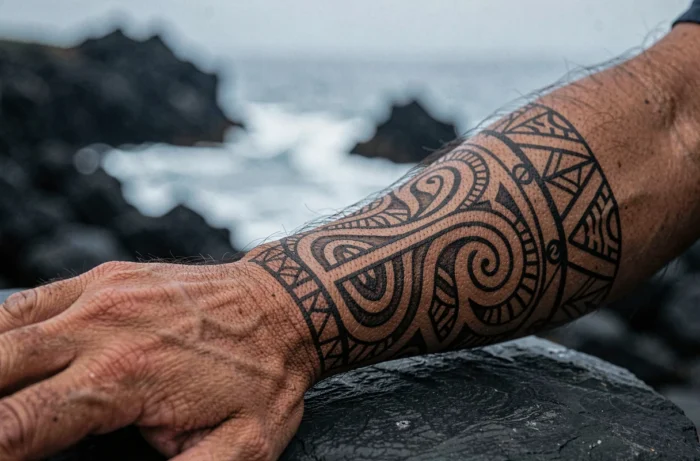
Sacred Māori motifs: reading forms beyond aesthetics
Several recurring motifs compose the visual vocabulary of tā moko and Polynesian tattooing more broadly. Their interpretation requires going beyond graphic appeal to understand what each form conveys.
The koru, a spiral inspired by the silver fern (New Zealand’s national symbol), represents growth, renewal, and a return to origins. Its curled shape evokes the cycle of life and the connection between past and future.
The spearhead motifs (matau) refer to courage and warrior strength. Placed on the arms or chest, they signal the achievements of the wearer.
The manaia, a hybrid figure that is part human and part bird, serves as a spiritual guardian. It ensures the protection of the wearer and symbolizes the balance between the physical and spiritual worlds.
The parallel lines and geometric patterns that connect these elements are not decorative. They structure the reading of the tattoo like a sentence structures a narrative: each segment connects two pieces of information and creates meaning through its relative position.
Traditional Māori tattooing technique: the uhi and ink in the skin
The original technique of tā moko fundamentally differs from needle tattooing. The tohunga tā moko used an uhi, a bone chisel (often made from albatross bone) dipped in a pigment made from burnt kauri resin or charred caterpillars. The ink was literally carved into the skin, creating raised grooves rather than flat lines.
This technique produced a tactile texture on the face, a relief that could be felt by touch. The result visually and physically differed from a tattoo done with a modern machine. Since the 1970s, some tohunga tā moko have reintroduced the uhi into their practice, while others combine traditional tools with contemporary machines to address current health concerns.
The national museum Te Papa Tongarewa in Wellington documents the evolution of these tools and processes, showing how the practice has adapted without losing its ceremonial framework.
The tā moko remains a living art, carried by practitioners who refuse to reduce it to a catalog of exportable symbols. Its interpretation requires context, a relationship to the wearer, and an understanding of the culture that produced it. It is this demand that distinguishes it from any other tattoo style.